

- Research
- NeurIPS
- Time-Series Transformers
From Würzburg to Vancouver: Time-Series Transformers research presented at NeurIPS 2024
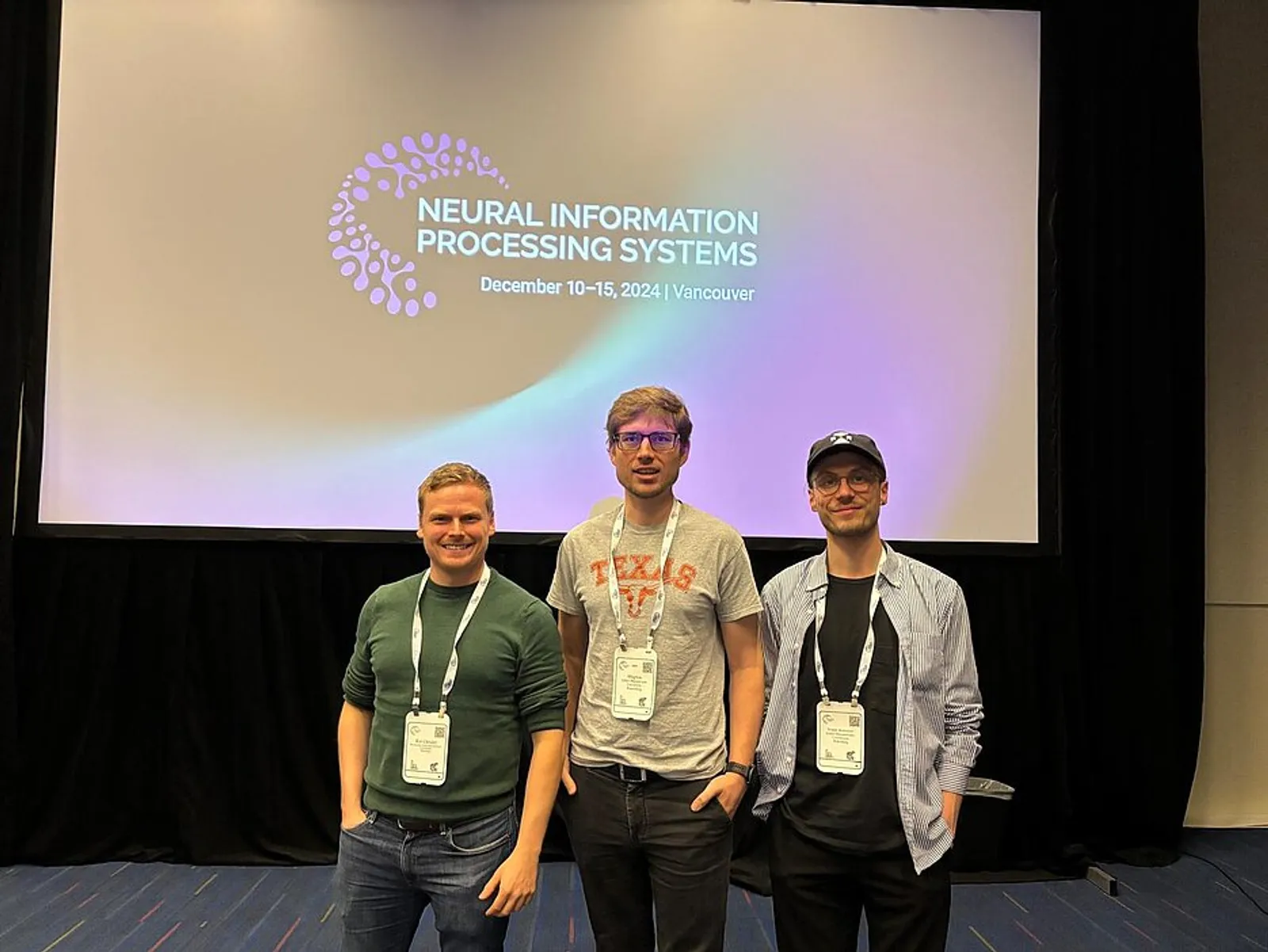
In December 2024, Kai Günder and Magnus Maichle from our team, together with Ivane Antonov, attended NeurIPS in Vancouver – one of the most important conferences for artificial intelligence and machine learning worldwide. There we presented our research on Time-Series Transformers for inventory management at the workshop “Time Series in the Age of Large Models”.
Taking part was an important milestone for our research at the Chair of Logistics and Quantitative Methods at the University of Würzburg – the scientific foundation for our spin-off. In an international setting where leading research teams work on the next generation of foundation models, transformer architectures and scalable learning methods, we were able to show how modern AI approaches can be transferred to concrete challenges in logistics and supply chain management.
What we presented
At the center was the paper “In-context Quantile Regression for Multi-product Inventory Management using Time-series Transformers”. In it, we investigate how transformer models can be used for a central challenge in inventory management: producing precise probabilistic demand forecasts across many products — including for new or previously unseen planning situations.
Our approach transfers core ideas of modern foundation models to time series in logistics. Instead of training a separate model for each product, product group or use case, the model learns patterns across many products. This allows it to use knowledge from existing time series to make better predictions for new products as well. That is exactly what matters when AI in inventory management should not stop at better individual forecasts, but instead automate operational planning at scale.
What NeurIPS meant for us
The conference provided the ideal setting for this. The workshop brought together researchers working at the intersection of large models, time-series forecasting and real-world use cases. The exchange with international experts from academia and industry was particularly valuable — for example on questions such as: How can foundation models be transferred to structured time-series data? How robust are such models in real applications? And how can companies derive better operational decisions from complex forecasts? At the same time, we took a lot away: questions about the robustness of such models in practice, new impulses for our next research steps and conversations that show where development in the field of foundation models for structured data is currently heading.
Why this drives us
From the very beginning, our research was more than an academic topic for us. It addresses a practical problem that many companies know: inventory decisions have to be made regularly, across many products and under uncertainty. Better probabilistic forecasts are a central building block for this — not as an end in themselves, but as the basis for better operational decisions.
The presentation at NeurIPS 2024 confirmed that the combination of time-series foundation models and inventory management also generates strong interest internationally. At the same time, the exchange in Vancouver was an important impulse for the next research steps and the further development of the underlying technology.
We look forward to advancing this work further — from the scientific foundation toward AI systems that make inventory planning more precise, more scalable and more automated in practice.